Alabaster and Light
Alabaster occupies an unusual position between stone and light. Solid enough to be carved, yet translucent enough to glow when illuminated, it offers a way of working with light that is fundamentally different from glass, metal or fabric.
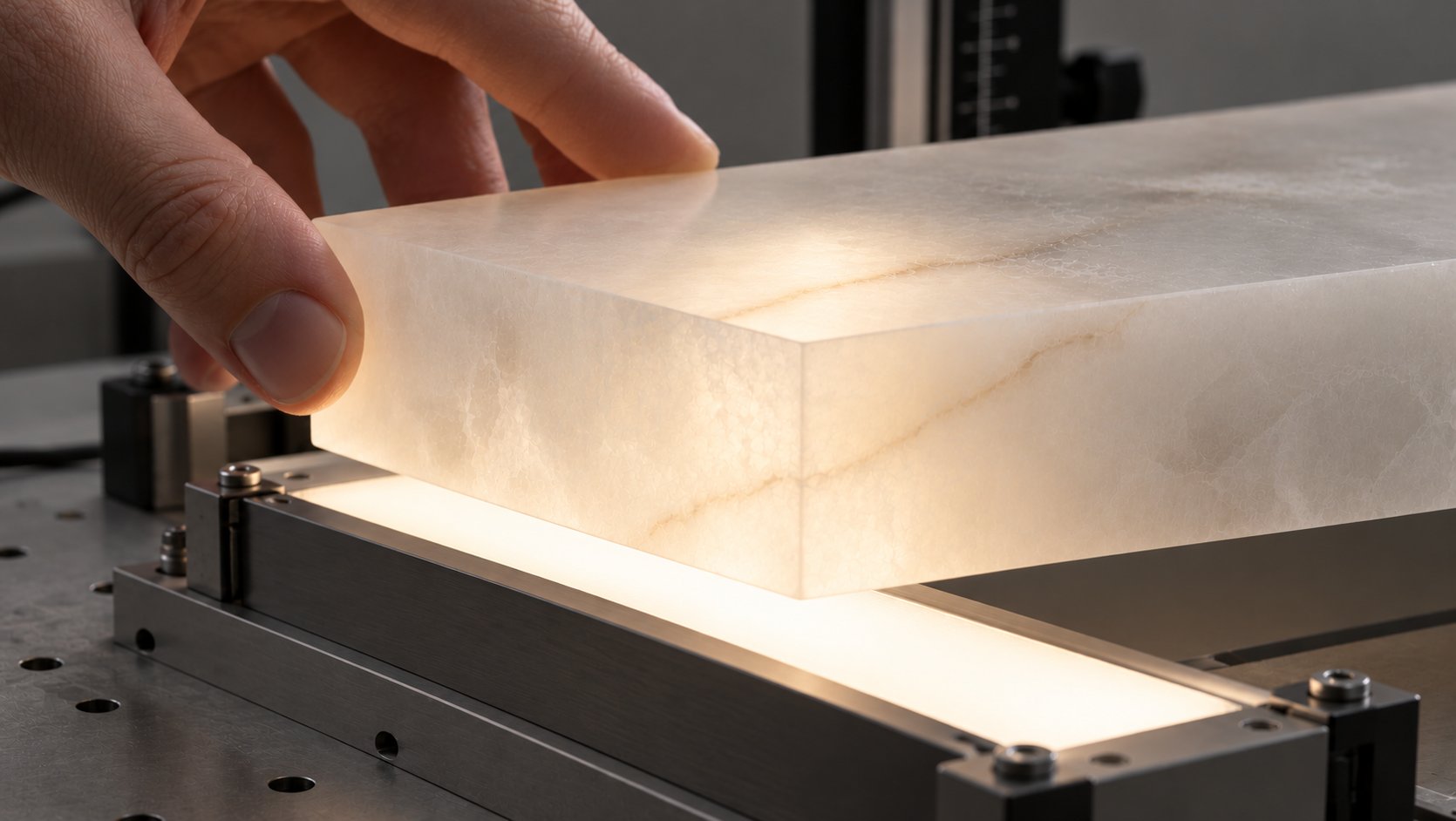
Its appeal lies in this duality. Light does not simply fall upon the surface; it enters the material, scatters within it and emerges softened. The result is an illumination shaped by the physical character of the stone itself.
For designers, alabaster presents a distinctive relationship between material, form and atmosphere. Its natural variations make every piece different, while its limitations demand careful consideration of how an object is designed, constructed and used.
Two minerals, one name
The term alabaster describes two different minerals: gypsum and calcite. Although they can look similar, their composition and physical properties differ.
Gypsum alabaster is a fine-grained form of hydrated calcium sulphate. It is relatively soft, typically measuring around 2 on the Mohs hardness scale. Calcite alabaster, sometimes referred to as Egyptian alabaster, is composed primarily of calcium carbonate and is harder, at around 3 on the same scale.
| Stone | Composition | Mohs hardness |
|---|---|---|
| Gypsum alabaster | Hydrated calcium sulphate | Around 2 |
| Calcite alabaster, or Egyptian alabaster | Calcium carbonate | Around 3 |
Both materials have been used for decorative objects and sculpture, but gypsum alabaster is particularly valued for its capacity to transmit and diffuse light.
The distinction is important because the name alone does not establish the precise properties of a particular stone. Its origin, composition, thickness and internal structure all influence its appearance and suitability for a given application.
Reference: The Metropolitan Museum of Art — conservation literature on alabaster
The behaviour of light
The defining quality of alabaster is its translucency.
Unlike clear glass, which can transmit light with relatively little scattering, alabaster diffuses light as it passes through the stone. Its fine-grained structure redirects light within the material, producing a softer, more dispersed glow.
The effect depends on several variables. Thinner sections generally transmit more light, while thicker sections tend to appear more opaque. Natural veining, inclusions and differences in density create further variation, giving the illuminated stone depth and visual complexity.
When a light source is positioned behind alabaster, the stone becomes part of the optical system. It conceals the direct source of light while allowing its presence to remain visible. Rather than producing a sharply defined beam, the material creates a more diffuse field of illumination.
This is what makes alabaster particularly interesting in lighting design. Its performance cannot be separated from its physical form. The thickness of the stone, the geometry of the object and the position of the light source all contribute to the final effect.
Reference: Volterra Tourism — A Mineral Made of Light
A material with a long history
Alabaster has a history extending back thousands of years. Its relative workability made it suitable for carving, while its colour, polish and, in some varieties, translucency gave it a particular appeal for decorative and ceremonial objects.
In ancient Egypt, calcite alabaster was used for vessels, sculpture and architectural details. Elsewhere, gypsum alabaster became an important material for carved objects and religious works.
The Tuscan town of Volterra provides a particularly well-documented example of the relationship between alabaster and craftsmanship. Etruscan workshops produced alabaster funerary urns from around the third century BC, carving detailed scenes and figures into the stone. Many of these objects combined the qualities of the material with a high level of sculptural detail.
The tradition continued through later centuries, evolving from religious and decorative objects towards domestic furnishings and lighting. By the seventeenth century, Volterran artisans were using alabaster to make lamps, taking advantage of its ability to produce a soft light from within the stone.
The history of Volterra demonstrates that alabaster is not simply a geological material. It is also a material shaped by accumulated knowledge: the ability to identify suitable blocks, understand their internal structure and work them without compromising their natural qualities.
References:
- Official Volterra tourism resource — Alabaster Throughout History
- Rijksmuseum van Oudheden — Volterran Cinerary Urn
Alabaster in architecture
The use of translucent stone in architecture offers another expression of its relationship with light.
Thin alabaster panels have been used in architectural glazing to admit daylight while diffusing its intensity. Unlike transparent glass, which establishes a direct visual connection between inside and outside, translucent stone softens that relationship. Light enters the space without necessarily revealing a clear view beyond the opening.
This quality has particular relevance in religious and contemplative architecture, where illumination can contribute to the atmosphere of a space without becoming visually dominant.
Contemporary architecture continues to explore the relationship between natural stone and daylight, although the precise materials and construction methods vary between projects. Claims about specific buildings, their glazing systems or their thermal performance should be considered in the context of their technical documentation rather than inferred from appearance alone.
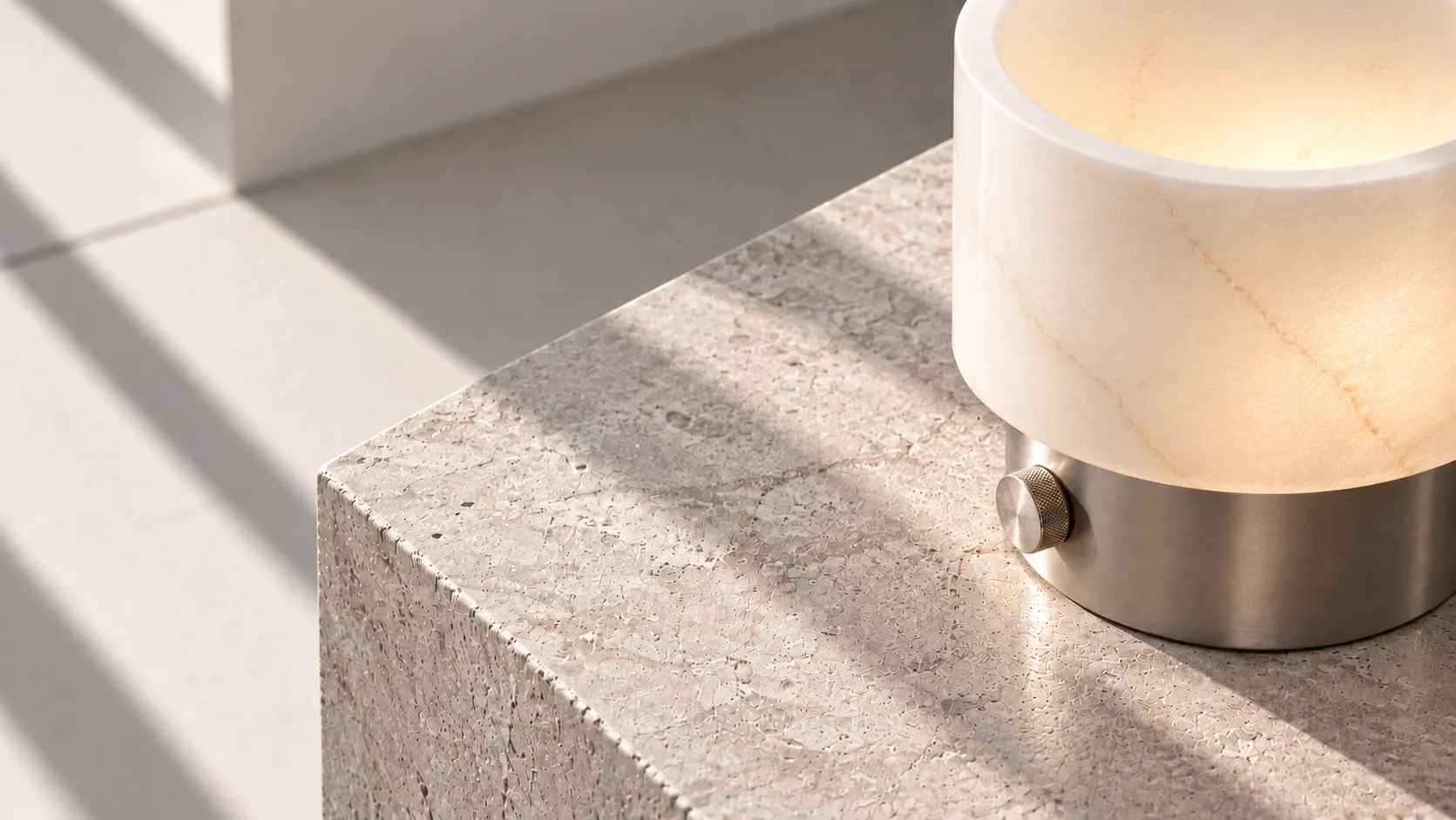
For lighting designers, the architectural principle remains relevant at a smaller scale. Alabaster can establish a boundary between the light source and the surrounding space, filtering the former into a more integrated part of the latter.
The importance of thickness and form
The optical qualities of alabaster create both opportunities and constraints for product design.
A thin section can produce a pronounced glow, revealing the stone’s internal pattern and allowing the light source to influence its appearance. A thicker section can appear more substantial and opaque, with illumination concentrated in areas where the stone permits greater transmission.
Neither effect is inherently better. The appropriate balance depends on the intended character of the object.
The geometry of the stone is equally important. Curved surfaces, sharp edges and changes in section thickness can alter how light is distributed. The relationship between illuminated and unilluminated areas creates contrast, giving an object a different presence when switched on and off.
Natural variation introduces another dimension. Two pieces cut from the same block may differ in their veining, colour and light transmission. This means that the final appearance cannot always be determined by the geometry of a design alone. Material selection and prototyping are essential parts of the process.
In a considered object, these variables are not necessarily imperfections to be eliminated. They are characteristics to be understood and incorporated into the design.
Working with the material
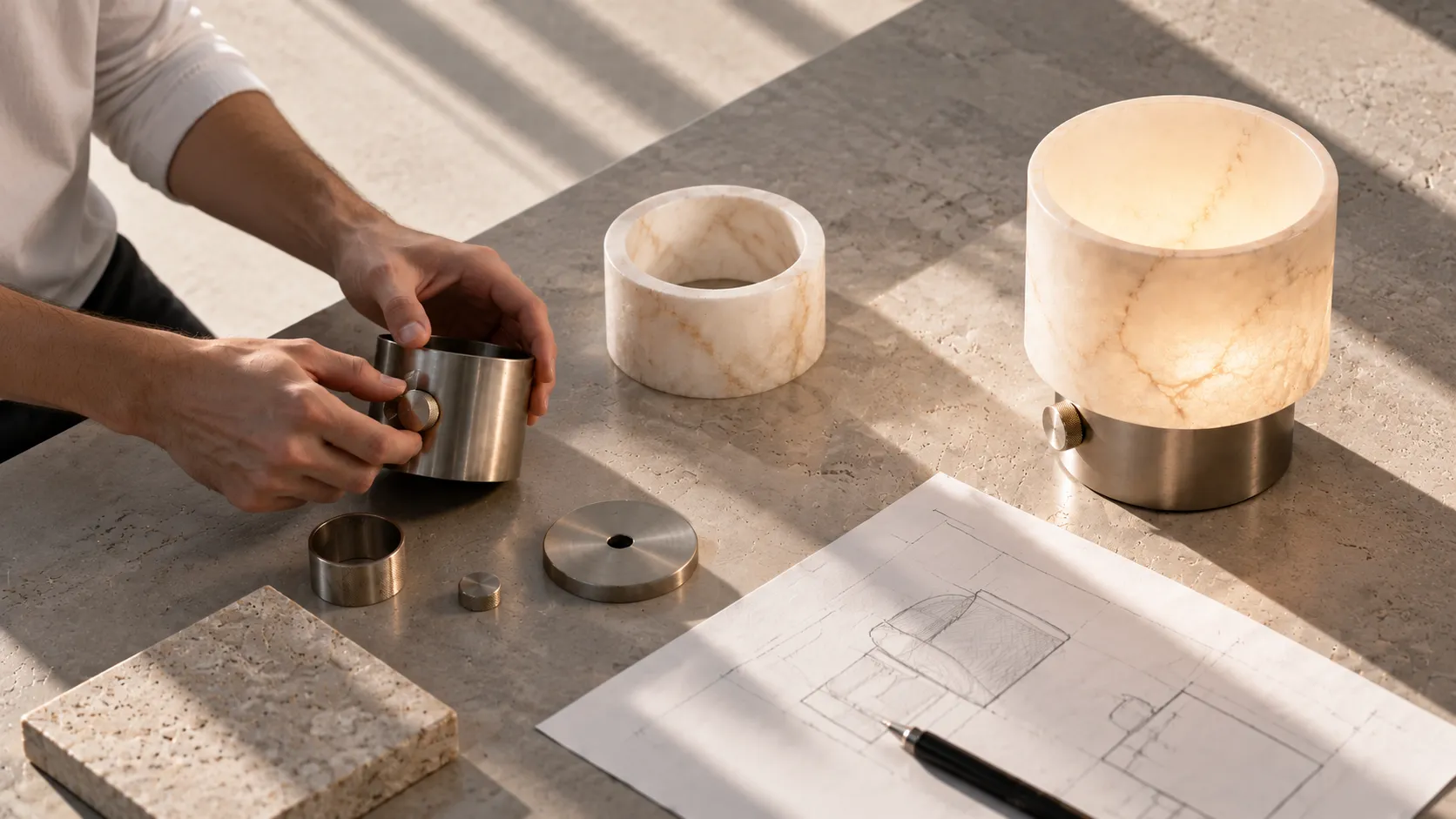
Alabaster’s softness is one of its defining characteristics. Gypsum alabaster can be scratched or chipped more readily than harder stones, making the design of edges, supports and contact surfaces particularly important.
Its sensitivity to moisture also requires consideration. Gypsum is slightly soluble in water, and prolonged exposure to moisture or unsuitable cleaning methods can damage the surface. For this reason, gypsum alabaster is generally better suited to dry interior environments than to outdoor applications or persistently wet areas.
Maintenance should be equally restrained. Gentle dry dusting is the safest general approach for routine cleaning. Abrasive materials, household cleaning products and untested treatments should be avoided unless their suitability has been confirmed by the maker or a conservation specialist.
Heat management is another important consideration when alabaster is used in lighting. Gypsum loses water from its crystal structure when heated sufficiently, potentially changing its physical properties. The effect depends on the temperature and duration of exposure; ordinary warmth should not be confused with the conditions required for significant dehydration.
A well-considered lighting design should account for the heat generated by the light source, the distance between that source and the stone, and the opportunity for heat to dissipate. The appropriate solution will depend on the construction and dimensions of the individual object.
These considerations do not diminish the material’s value. They define the conditions under which it can be used successfully.
Stone as a source of illumination
Alabaster offers a particular way of thinking about the relationship between an object and its environment.
Its presence is not defined solely by its silhouette or surface finish. When illuminated, the stone reveals another dimension: its capacity to receive light, hold it momentarily within its structure and release it into the surrounding space.
The resulting effect is neither entirely solid nor entirely immaterial. The stone retains its physical presence while becoming a source of visual softness.
For ORTON, this is what makes alabaster compelling as a material for lighting. It brings together qualities that are often treated separately in product design: structure and atmosphere, permanence and variation, the physical object and the light it produces.
The objective is not to disguise the stone or to make it behave like another material. It is to design around its particular properties, allowing its natural character to determine how the finished object is experienced.
References and further reading
- The Metropolitan Museum of Art — museum collections and conservation literature relevant to the identification and properties of alabaster.
- Volterra Tourism — A Mineral Made of Light — an introduction to the translucency, geology and material qualities of Volterran alabaster.
- Volterra Tourism — Alabaster Throughout History — historical account of alabaster craftsmanship in Volterra.
- Rijksmuseum van Oudheden — Volterran Cinerary Urn — museum documentation of Etruscan alabaster and tuff funerary urns.